| USA
Blood
for Dracula
Burden
of Dreams
Criminals
Flesh
Flesh
for Frankenstein
Heat
Interviews
with My Lai Veterans
Janice
Jazz
on a Summer's Day
Madame
Wang's
Mixed
Blood
Muscle Beach
The
Savage Eye
Steppenwolf
Trash
Women
in Revolt |
BLOOD
FOR DRACULA
(1974, Colour) Director: Paul Morrissey
If you wanted to enjoy Blood for Dracula as pure entertainment, Morrissey gives
you this outlet in spades. However, behind the goofiness lies the heart of
a film that actually bothers to look at Dracula in a way that hadn't been done
before.
BURDEN
OF DREAMS
(1982, Colour) Director: Les Blank
'Burden of Dreams' documents the making of Werner Herzog's film Fitzcarraldo.
The film is a fascinating record of an obsessed film-maker's battle to finish
his work against all odds.
CRIMINALS
(1996, Colour)
Director:Joseph Strick
This a fierce documentary about crime in America featuring the action of decoy
squads police videotapes of crimes in progress, unimaginable confessions and
some heroic resistance.
FLESH
(1968, Colour)
Director: Paul Morrissey
The opening
sequence of Paul Morrissey’s Flesh
compellingly breaks all of the rules
cinema (notably, never frame a single
shot longer than thirty seconds), but
in so doing signals the start of an amazing
treatise on family life in the laissez-faire
world of the late ‘60s.
FLESH
FOR FRANKENSTEIN
(1973, Colour)
Director: Paul Morrissey
In most filmed
versions of the Frankenstein legend, Baron
Frankenstein is merely a mad scientist
whose reanimation project leads to monstrous
results. Morrissey's black comedy takes
a different approach to the story. In Flesh
for Frankenstein, the baron is a degenerate
married to his sister. Holding his own
silent, voyeuristic offspring in contempt,
Frankenstein's reanimation experiments
are aimed at producing a "perfect," beautiful
pair of zombies who will in turn produce
children.
HEAT
(1972, Colour)
Director: Paul Morrissey
Continuing
his examination of fading society, Morrissey
turns to fame and travels from New York
to Los Angeles for this outrageously
funny but almost painfully sharp comedy.
With a much bigger budget than the earlier films, slicker editing, glorious
photography and a strong John Cale score, this is a polished, dialog-based
film . But as it takes a swipe at everything from sexuality to showbiz, it
stays consistently entertaining and very telling.
INTERVIEWS
WITH MY LAI VETERANS
(1970, Colour) Director: Joseph
Strick
Terrifying and indescribably
sad, this piece of cinema-verite is a series of interviews with five
men who participated in the My Lai action in Vietnam, all of whom are
now out of the army. These clean-cut American lads recount with smiles,
indifference and poise, how and why they murdered.
JANICE
(1973, Colour)
Director: Joseph Strick
Two
young truck drivers set out from New
Jersey with a load of meat. On the
journey they pick up Janice - for a
price. From that moment on bad luck
strikes at them from all sides......
An original work of art - the Observer
JAZZ
ON A SUMMER'S DAY
(1959,
Colour) Director: Bert Stern
In
1958, a 28 year old Bert Stern had built for himself a reputation as
one of the world's leading fashion and advertising photographers. Although
he had ambitions to turn his talent to film, the opportunity did not
present itself until the founder of the Newport Jazz Festival invited
him to "take some pictures". That request would evolve into a full-fledged
motion picture presenting some of the most remarkable scenes of live
jazz ever brought to the screen. Performers include Louis Armstrong,
Gerry Mulligan, Mahalia Jackson, Thelonius Monk, Chuck Berry and Chico
Hamilton.
MADAME
WANG'S
(1981, Colour) Director: Paul Morrissey
Lutz (Patrick Schoene), is a self-proclaimed
East German sailor-spy who has jumped ship while in Long Beach harbor
so he can prepare the way for a planned Soviet invasion. Lutz is a handsome,
musclebound type who attracts a following as diverse as a mixed salad:
a rotund mother and son whose affection for hamburgers, fries, and ice-cream
is self-evident, a gay pimp cum door-knob collector, an attractive call-girl
from the Temple of Dance Arts, and other flotsam and jetsam of the human
condition. The antics of this troupe enliven the film as they head to
Madame Wang's punk show, where Lutz shows off an eccentricity of his
own.
MIXED
BLOOD
(1985,
Colour) Director: Paul Morrissey
Brazilian
drug dealers in the lower east side of Manhattan start a war with a
rival gang of Latino drug dealers. Their soldiers are Latino kids all
under 17 because, as Rita La Punta says, "They can kill and not
go to jail." The war escalates to include their German heroin
supplier, his sexy English girl friend, a Puerto Rican ex-cop, and
the Japanese police captain. This movie is about racism, police corruption,
junkies and drug dealing. There is plenty of killing and even a visit
to a store dedicated to the Latino pop group "Menudo."
MUSCLE
BEACH
(1948,
B/W) Director: Joseph Strick
On
a beach in Southern California acrobats and muscle- builders flaunt
their skills and poses. A singing narration takes note of their obsessions.
A
PORTRAIT OF THE ARTIST AS A YOUNG MAN
(1977, Colour) Director: Joseph
Strick
Joseph (Ulysses) Strick returns to his favourite author James
Joyce. An outstanding achievement - Films & Filming.
THE
SAVAGE EYE
( 1958, B/W)
Director: Joseph
Strick
Judith McGuire, young and divorced, suddenly finds herself cut off
from the life she knew so well. To escape the ghosts of old memories
she immerses herself
in every form of pleasure and sensationalism she can find...... A work of startling
and disturbing brilliance - The Daily Mail
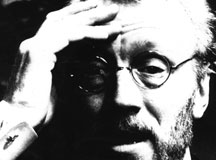
STEPPENWOLF
(1974, Colour) Director:
Fred Haines
This Faust-like and magical story of the humanization of a middle-aged misanthrope
is a self-portrait of a man who felt himself to be half-human and half wolf.
This stunning film is as faithful an adaptation of Herman Hesse's poetical novel
as one could possibly expect.
TRASH
(1970,
Colour)
Director: Paul Morrissey
Joe Dallesandro stars as the impotent heroin-addict,
suspended in a state of asexual bliss and perpetual disconnection, and
the film thinly – and mostly hilariously – follows the attempts
of many women (and men) to seduce him, and those of his live-in girlfriend
to salvage him/them-as-a-couple (a great, celebrated performance by transvestite
actress, Holly Woodlawn). Those brave enough to venture into the film
will be rewarded with an unyielding canvas of transitory but chilling
emotional truths. At the end, it's up to the viewer whether to take it
seriously or not, but either way, it's essential viewing.
WOMEN
IN REVOLT
(1971, Colour)
Director: Paul Morrissey
This film
is a satire of the women's liberation movement,
staring a trio of female impersonators. Candy
(Candy Darling) is an aloof heiress caught
in an unhappy relationship with her brother.
Jackie (Jackie Curtis) is a virginal intellectual
who believes women are oppressed in contemporary
American society. And Holly (Holly Woodlawn)
is a nymphomaniac who has come to loathe
men, despite her attraction to them. Together,
they join a militant feminist group, P.I.G.
(Politically Involved Girls), but their newfound
liberation doesn't make them any happier.
|